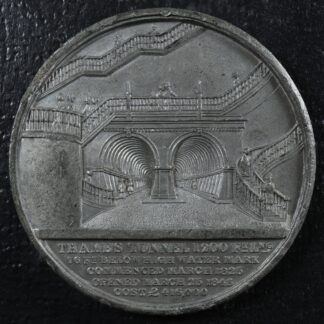
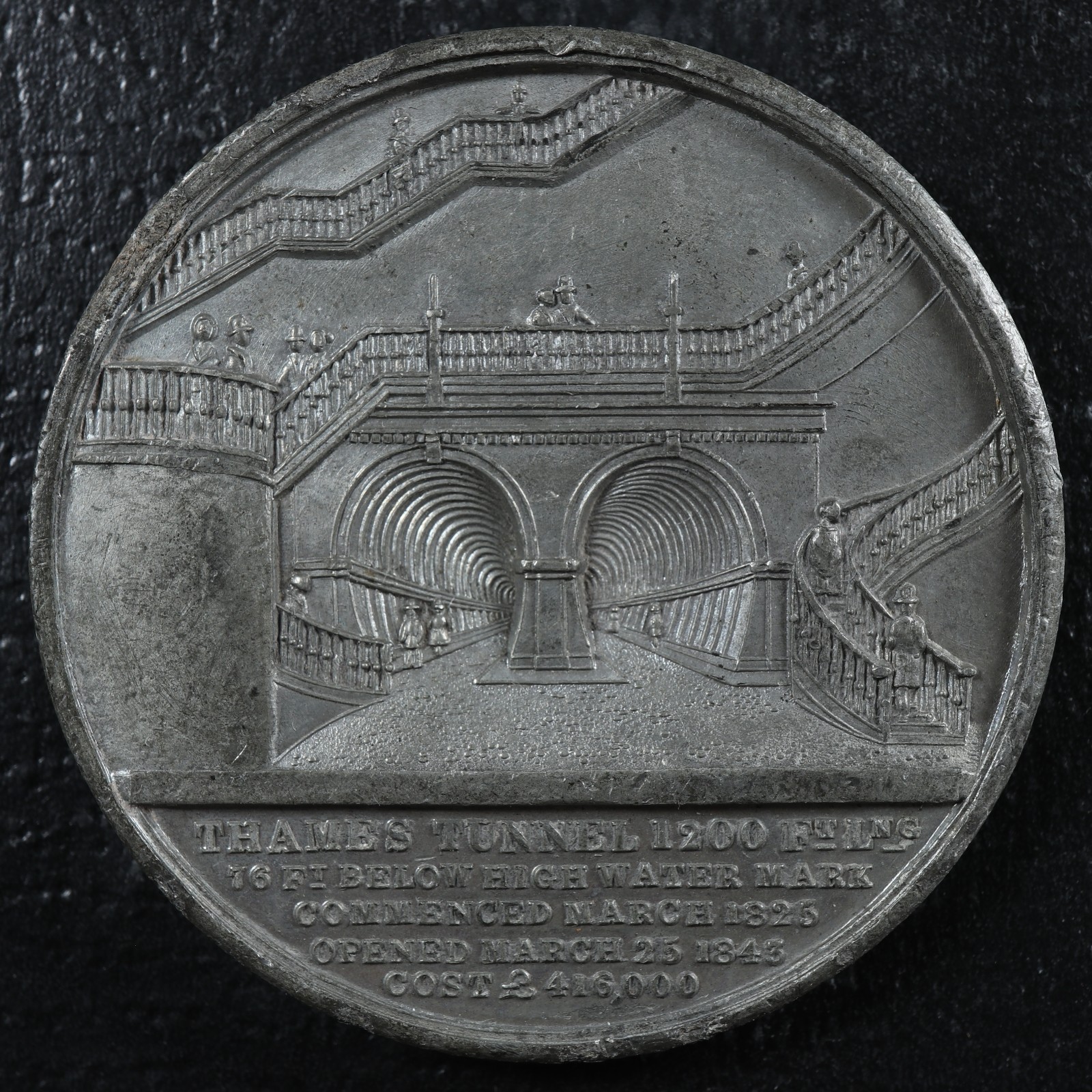
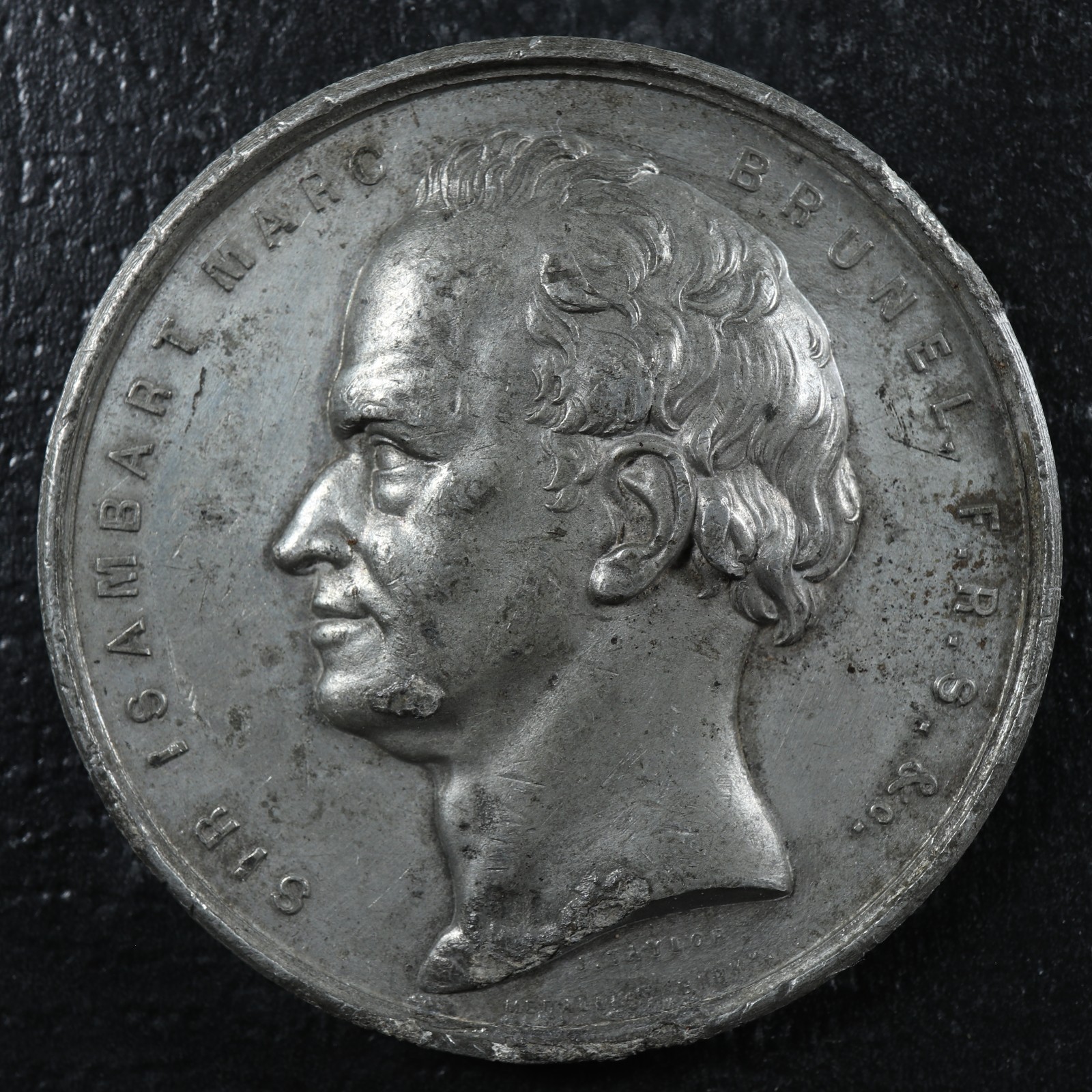
Opening of the Thames Tunnel London 1843 Sir Marc Isambard Brunel Medal 48mm
Opening of the Thames Tunnel in London, 1843, Sir Marc Isambard Brunel Medal
BHM 2136(?).
By J. Taylor.
Edge : Smooth.
White Metal.
35.93 g
48.4 mm
Damaged.
The Thames Tunnel is a tunnel beneath the River Thames in London, connecting Rotherhithe and Wapping. It measures 11 m (35 ft) wide by 6.1 m (20 ft) high and is 400 m (1,300 ft) long, running at a depth of 23 m (75 ft) below the river surface measured at high tide. It is the first tunnel known to have been constructed successfully underneath a navigable river.
It was built between 1825 and 1843 by Marc Brunel, and his son, Isambard, using the tunnelling shield newly invented by the elder Brunel and Thomas Cochrane. The tunnel was originally designed for horse-drawn carriages, but was mainly used by pedestrians and became a tourist attraction. In 1869 it was converted into a railway tunnel for use by the East London line which, since 2010, is part of the London Overground railway network under the ownership of Transport for London. (Taken from Wikipedia)
______________________________
In stock
Related products
-
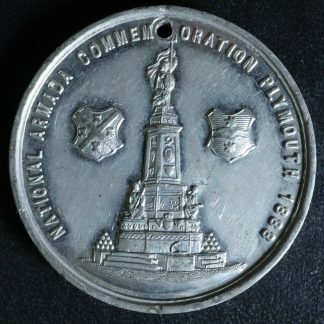

Queen Victoria National Armada Commemoration Plymouth 1888 Miller medal England
$150.00 Add to cartMedal of Queen Victoria and the National Armada Commemoration Plymouth 1888, from Miller, Birmingham19.63g38.7 mmProbably white metal.Nicer in hand.Welcome to Jetons Canada.We do combine shipping. Only pay shipping once(most expensive one), all the added items are free of shipping charges.Here you know what you buy.Pictures show the actual item you will get so make sure you take a good look.We take high quality pictures and we don't retouch them.If you have questions, don't hesitate, we will happily answer you. And please ask BEFORE you buy, not after.We have more items, make sure you take a look.Canadian residents will have to pay taxes. No tax is charged on out of country purchases.All customs, duties, and processing fees for international orders are the responsibility of the recipient.Thank you! Merci!Nous parlons français aussi alors n'hésitez pas. -
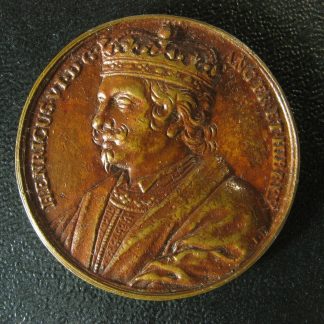
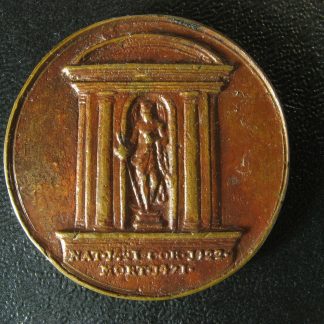
King Henry VI Jean Dassier medal 1730s 38mm 26.59g England
$75.00 Add to cartMedal of King Henry VI from Jean Dassier, 1730s. Possible restrike.38mm, 26.59g.Have more from that series. Buy many to combine the shipping! Pay 1 shipping buy as many as you want and no extra charge.This item will be shipped with a tracking number.Welcome to Jetons Canada.We do combine shipping. Only pay shipping once(most expensive one), all the added items are free of shipping charges.Here you know what you buy.Pictures show the actual item you will get so make sure you take a good look.We take high quality pictures and we don't retouch them.If you have questions, don't hesitate, we will happily answer you. And please ask BEFORE you buy, not after.We have more items, make sure you take a look.Canadian residents will have to pay taxes. No tax is charged on out of country purchases.All customs, duties, and processing fees for international orders are the responsibility of the recipient.Thank you! Merci!Nous parlons français aussi alors n'hésitez pas. -
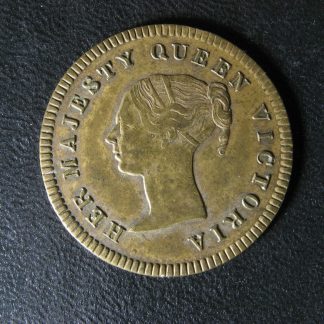
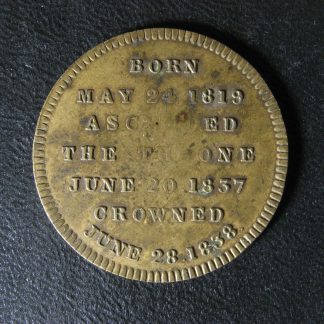
Medallion Queen Victoria Crowned 1838 28mm 5.14g England Great Britain GB
$150.00 Add to cartLooks like a brass medalet, medallion or medal of Queen Victoria.About 28mm, 5.14g.Seem rarely offered.This item will be shipped with a tracking number.Welcome to Jetons Canada.We do combine shipping. Only pay shipping once(most expensive one), all the added items are free of shipping charges.Here you know what you buy.Pictures show the actual item you will get so make sure you take a good look.We take high quality pictures and we don't retouch them.If you have questions, don't hesitate, we will happily answer you. And please ask BEFORE you buy, not after.We have more items, make sure you take a look.Canadian residents will have to pay taxes. No tax is charged on out of country purchases.All customs, duties, and processing fees for international orders are the responsibility of the recipient.Thank you! Merci!Nous parlons français aussi alors n'hésitez pas.